Civil Services Examination · Question 51
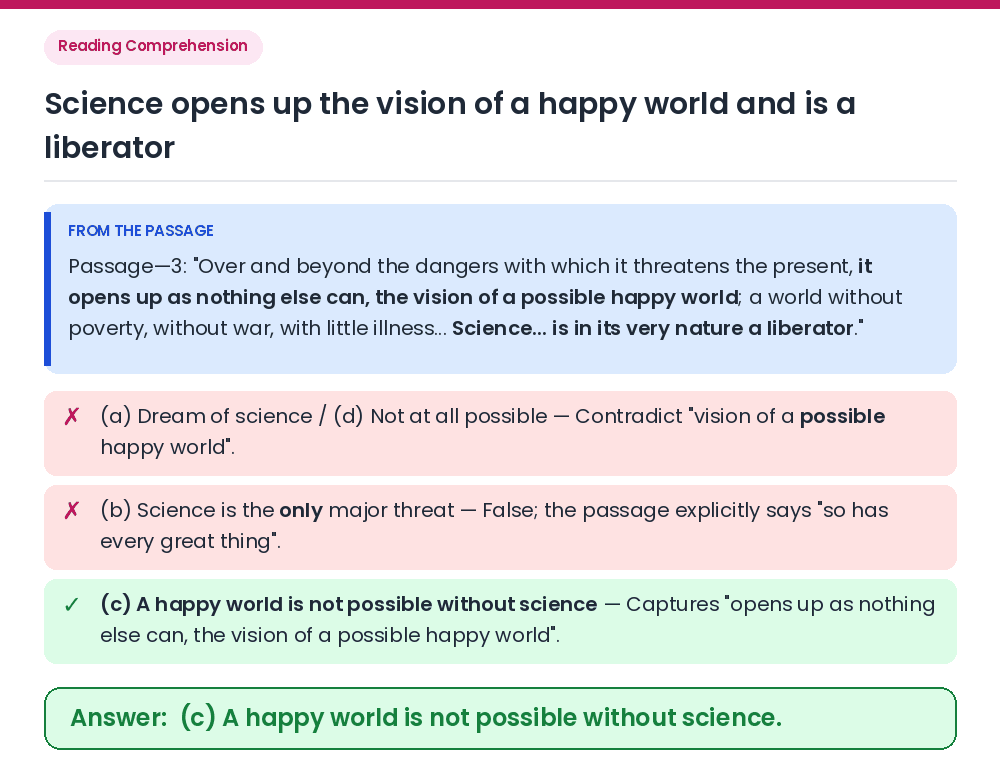
Passage—3 Scientific knowledge has its dangers, but so has every great thing. Over and beyond the dangers with which it threatens the present, it opens up as nothing else can, the vision of a possible happy world; a world without poverty, without war, with little illness. Science, whatever unpleasant consequences it may have by the way, is in its very nature a liberator. Which one of the following is the most important implication of the passage?
Show answer & explanationShow explanation
Answer: (C) A happy world is not possible without science.
Given: Passage—3 states that scientific knowledge 'opens up as nothing else can, the vision of a possible happy world; a world without poverty, without war, with little illness' and is by nature a 'liberator'. Analyze 'as nothing else can': The phrase 'as nothing else can' ('जो और किसी से नहीं हो सकता') implies that without science, such a happy world cannot be achieved. Eliminate Option b: The first sentence states 'Scientific knowledge has its dangers, but so has every great thing'—meaning science is NOT the 'only' major threat. Eliminate Options a and d: The passage calls it a 'possible happy world', not a mere dream or impossibility. Hence (c) is the correct implication. Correct Answer: (c) A happy world is not possible without science.