Civil Services Examination · Question 54
Passage—6 India's educational system is modelled on the mass education system that developed in the 19th century in Europe and later spread around the world. The goal of the system is to condition children as 'good' citizens and productive workers. This suited the industrial age that needed the constant supply of a compliant workforce with a narrow set of capabilities. Our educational institutes resemble factories with bells, uniforms and batch-processing of learners, designed to get learners to conform. But, from an economic point of view, the environment today is very different. It is a complex, volatile and globally interconnected world. With reference to the above passage, the following assumptions have been made : 1. India continues to be a developing country essentially due to its faulty education system. 2. Today's learners need to acquire new-age skill-sets. 3. A good number of Indians go to some developed countries for education because the educational systems there are a perfect reflection of the societies in which they function. Which of the above assumptions is/are valid?
Show answer & explanationShow explanation
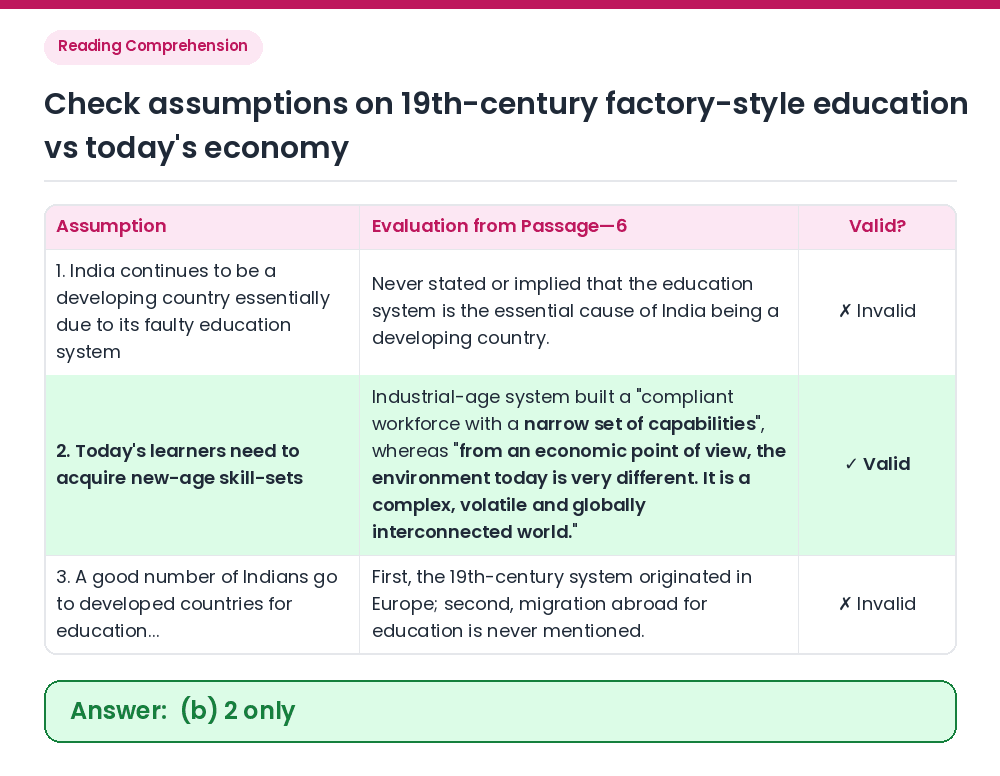
Answer: (B) 2 only
Given: Passage—6 contrasts the 19th-century industrial education model ('narrow set of capabilities', conformity) with today's 'complex, volatile and globally interconnected' economic environment. Check Assumption 1: The passage does not blame the education system for India being a developing country (1 is invalid). Check Assumption 2: Because the old system provides only a 'narrow set of capabilities' suited for the 19th-century industrial age, whereas today's world is 'complex, volatile and globally interconnected', today's learners clearly need new-age skill-sets beyond narrow conformity (2 is valid). Check Assumption 3: Student migration to developed countries is not mentioned anywhere in the passage (3 is invalid). Correct Answer: (b) 2 only