Civil Services Examination · Question 52
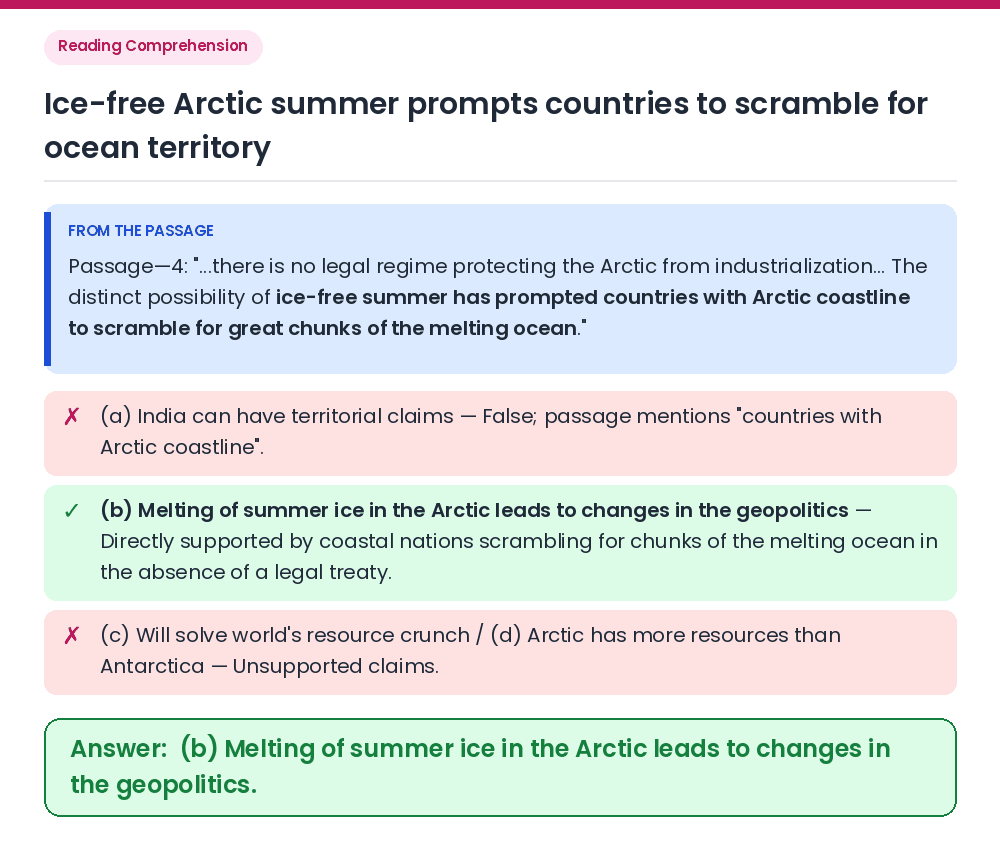
Passage—4 The Arctic's vast reserves of fossil fuel, fish and minerals are now accessible for a longer period in a year. But unlike Antarctica, which is protected from exploitation by the Antarctic Treaty framed during the Cold War and is not subject to territorial claims by any country, there is no legal regime protecting the Arctic from industrialization, especially at a time when the world craves for more and more resources. The distinct possibility of ice-free summer has prompted countries with Arctic coastline to scramble for great chunks of the melting ocean. Which one of the following is the most important implication of the passage?
Show answer & explanationShow explanation
Answer: (B) Melting of summer ice in the Arctic leads to changes in the geopolitics.
Given: Passage—4 explains that the Arctic lacks a protective treaty like Antarctica, and the possibility of an ice-free summer has prompted Arctic coastal nations to 'scramble for great chunks of the melting ocean'. Analyze the geopolitical impact: Countries scrambling to claim territory and resources in the melting Arctic ocean directly represents a shift in international geopolitics. Eliminate options: (a) India is not an Arctic coastline country; (c) and (d) make exaggerated comparisons or predictions not stated in the passage. Correct Answer: (b) Melting of summer ice in the Arctic leads to changes in the geopolitics.