Civil Services Examination · Question 53
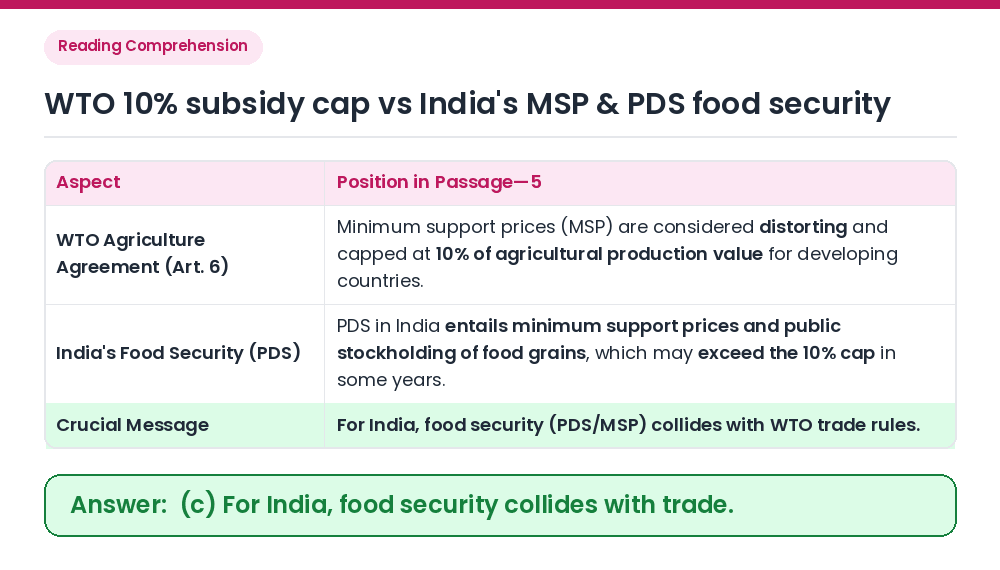
Passage—5 Being a member of the WTO, India is bound by the agreements that have been signed and ratified by its members, including itself. According to Article 6 of the Agriculture Agreement, providing minimum support prices for agricultural products is considered distorting and is subject to limits. The subsidy arising from 'minimal supports' cannot exceed 10 per cent of the value of agricultural production for developing countries. PDS in India entails minimum support prices and public stockholding of food grains. It is possible that, in some years, the subsidy to producers will exceed 10 per cent of the value of agricultural production. What is the crucial message conveyed by the above passage?
Show answer & explanationShow explanation
Answer: (C) For India, food security collides with trade.
Given: Passage—5 contrasts India's binding WTO Agriculture Agreement obligations (capping MSP subsidies at 10%) with India's PDS requirements (which rely on MSP and public stockholding and may exceed the 10% limit). Identify the central tension: On one side is international trade compliance (WTO cap of 10%); on the other side is domestic food security (PDS and MSP). Evaluate options: (a) and (b) are extreme policy recommendations not made by the author; (d) is a partial fact that misses the WTO conflict. Conclusion: Option (c) 'For India, food security collides with trade' captures the exact conflict described. Correct Answer: (c) For India, food security collides with trade.