Civil Services Examination · Question 7
Directions for the following 4 (four) items : Read the following four passages and answer the items that follow. Your answers to these items should be based on the passages only. Passage—1 Global population was around 1.6 billion in 1990—today it is around 7.2 billion and growing. Recent estimates on population growth predict a global population of 9.6 billion in 2050 and 10.9 billion in 2100. Unlike Europe and North America, where only three to four per cent of population is engaged in agriculture, around 47 per cent of India's population is dependent upon agriculture. Even if India continues to do well in the service sector and the manufacturing sector picks up, it is expected that around 2030 when India overtakes China as the world's most populous country, nearly 42 per cent of India's population will still be predominantly dependent on agriculture. Which of the following is the most logical and rational inference that can be made from the above passage?
Show answer & explanationShow explanation
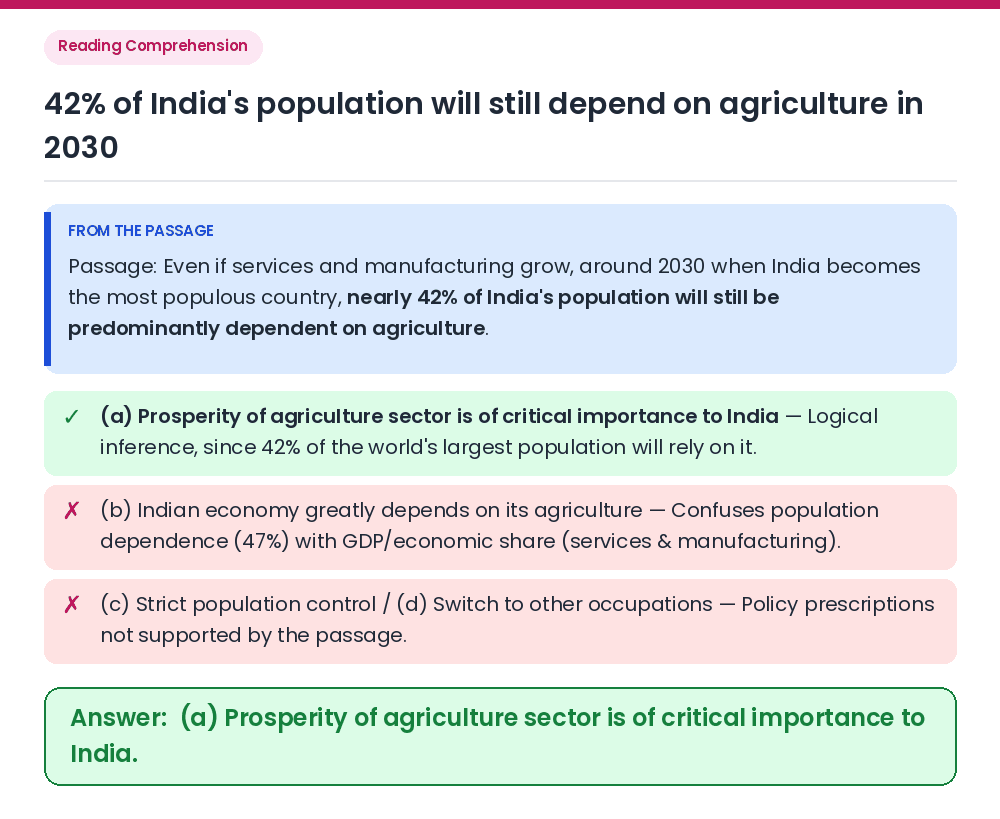
Answer: (A) Prosperity of agriculture sector is of critical importance to India.
Given: The passage highlights that 47% of India's population currently depends on agriculture, and even by 2030 (when India becomes the most populous country), nearly 42% will still depend on agriculture despite growth in services and manufacturing. Evaluate the core premise: Because a massive share (42%–47%) of India's huge population depends on agriculture for livelihood, the well-being of this population is tied to the agricultural sector. Eliminate flawed options: (b) equates population dependence with total economic (GDP) dependence; (c) and (d) suggest extreme policy actions not mentioned in the text. Conclusion: Therefore, the prosperity of the agriculture sector is of critical importance to India. Correct Answer: (a) Prosperity of agriculture sector is of critical importance to India.