Civil Services Examination · Question 8
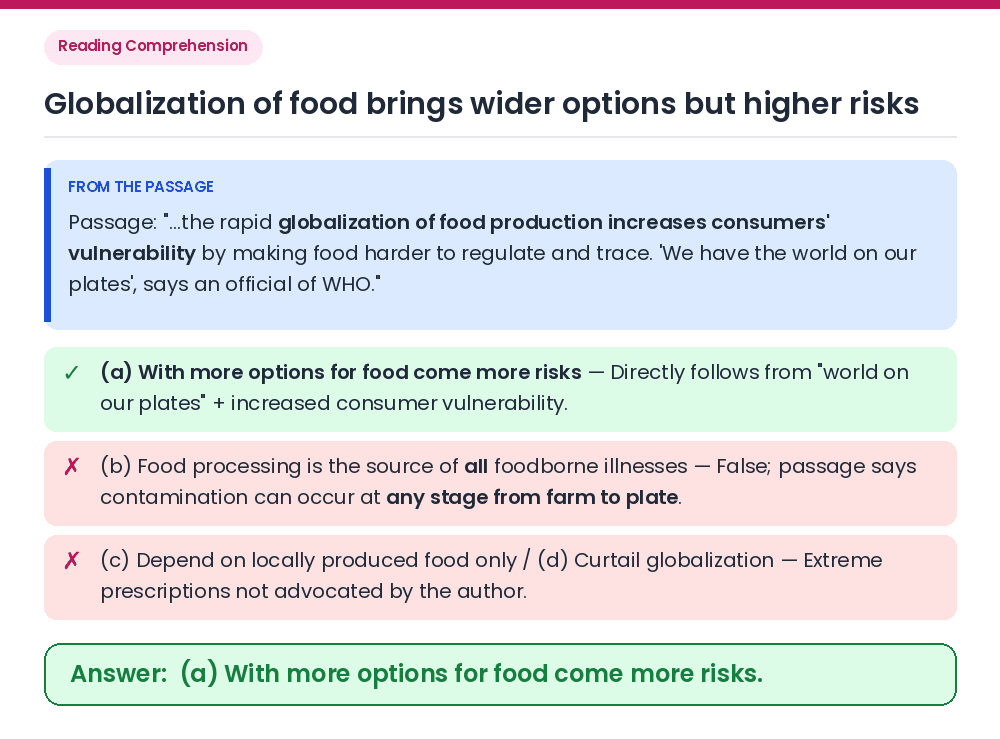
Passage—2 Many pathogens that cause foodborne illnesses are unknown. Food contamination can occur at any stage from farm to plate. Since most cases of food poisoning go unreported, the true extent of global foodborne illnesses is unknown. Improvements in international monitoring have led to greater public awareness, yet the rapid globalization of food production increases consumers' vulnerability by making food harder to regulate and trace. "We have the world on our plates", says an official of WHO. Which of the following is the most logical corollary to the above passage?
Show answer & explanationShow explanation
Answer: (A) With more options for food come more risks.
Given: Rapid globalization of food production puts 'the world on our plates' (more food options from around the globe) but increases consumers' vulnerability because food becomes harder to regulate and trace. Understand 'corollary': A corollary is a proposition that follows naturally from an already stated fact. Connect the last two sentences: Having global food variety ('the world on our plates') makes regulation and tracing harder, increasing vulnerability to foodborne risks. Eliminate options: (b) contradicts 'any stage from farm to plate'; (c) and (d) are extreme reactionary measures not implied by the text. Correct Answer: (a) With more options for food come more risks.