Civil Services Examination · Question 66
Passage – 4 A research team examined a long-term owl roost. Owls prey on small mammals and the excreted remains of those meals that accumulated over the time, provide us an insight into the composition and structure of small mammals over the past millennia. The research suggested that when the Earth went through a period of rapid warming about 13,000 years ago, the small mammal community was stable and resilient. But, from the last quarter of the nineteenth century, human-made changes to the environment had caused an enormous drop in biomass and energy flow. This dramatic decline in energy flow means modern ecosystems are not adapting as easily as they did in the past. On the basis of the above passage, the following assumptions have been made : 1. Global warming is a frequently occurring natural phenomenon. 2. The impending global warming will not adversely affect small mammals. 3. Humans are responsible for the loss of the Earth's natural resilience. Which of the above assumptions is/are valid?
Show answer & explanationShow explanation
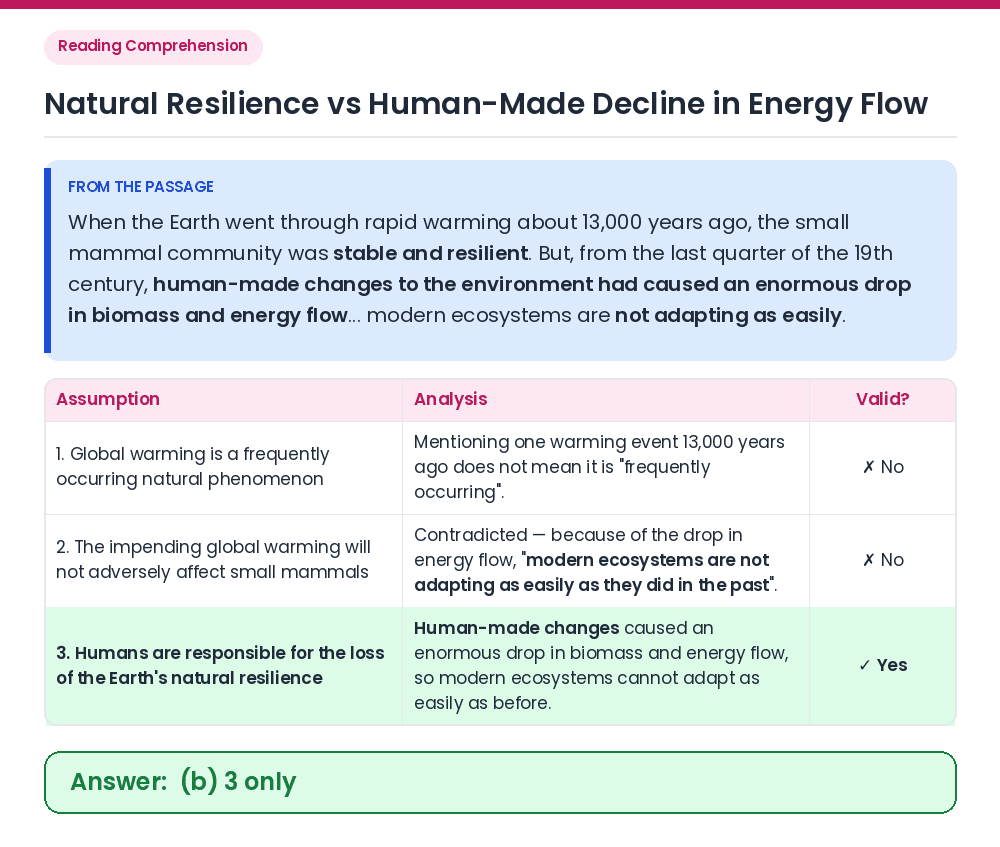
Answer: (B) 3 only
Check Assumption 1: Citing a single rapid warming period 13,000 years ago does not imply global warming is a 'frequently occurring' phenomenon. (Invalid) Check Assumption 2: While small mammals were resilient 13,000 years ago, the passage warns that due to human-made changes since the late 19th century, 'modern ecosystems are not adapting as easily as they did in the past'. Thus assuming impending warming will not affect them is false. (Invalid) Check Assumption 3: 'Human-made changes to the environment had caused an enormous drop in biomass and energy flow', reducing the ability of modern ecosystems to adapt (loss of natural resilience). (Valid) Result: Only assumption 3 is valid. Correct Answer: (b) 3 only