Civil Services Examination · Question 67
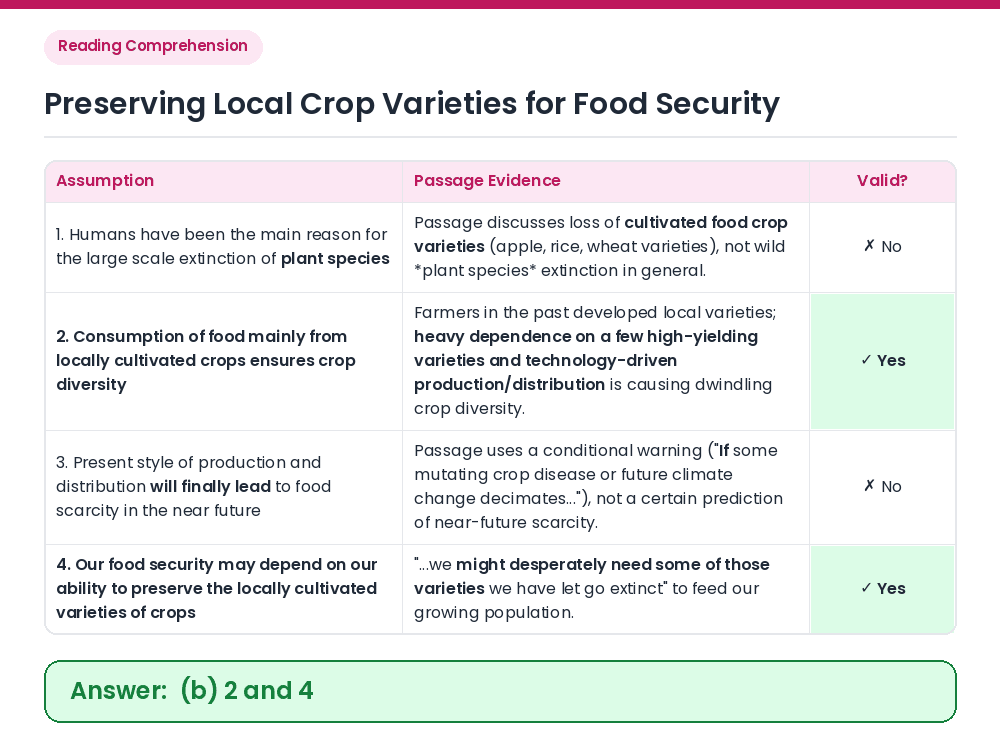
Passage – 5 Food varieties extinction is happening all over the world — and it is happening fast. For example, of the 7,000 apple varieties that were grown during the nineteenth century, fewer than a hundred remain. In the Philippines, thousands of varieties of rice once thrived; now only up to a hundred are grown there. In China, 90 percent of the wheat varieties cultivated just a century ago have disappeared. Farmers in the past painstakingly bred and developed crops well suited to the peculiarities of their local climate and environment. In the recent past, our heavy dependence on a few high yielding varieties and technology-driven production and distribution of food is causing the dwindling of diversity in food crops. If some mutating crop disease or future climate change decimates the few crop plants we have come to depend on to feed our growing population, we might desperately need some of those varieties we have let go extinct. On the basis of the above passage, the following assumptions have been made : 1. Humans have been the main reason for the large scale extinction of plant species. 2. Consumption of food mainly from locally cultivated crops ensures crop diversity. 3. The present style of production and distribution of food will finally lead to the problem of food scarcity in the near future. 4. Our food security may depend on our ability to preserve the locally cultivated varieties of crops. Which of the above assumptions are valid?
Show answer & explanationShow explanation
Answer: (B) 2 and 4
Check Assumptions 1 & 3: ⇒ Statement 1broadens 'food varieties' (apple, rice, wheat cultivars) into 'large scale extinction of plant species'. (Invalid) ⇒ Statement 3 turns a conditional risk ('If some mutating crop disease or future climate change decimates...') into an absolute certainty ('will finally lead to... in the near future'). (Invalid) Check Assumptions 2 & 4: ⇒ The passage contrasts past farmers who bred crops suited to local climate/environment with today's reliance on a few high-yielding varieties and centralized distribution — supporting that relying on locally cultivated crops maintains crop diversity (2). ⇒ The final sentence warns that if disease or climate change strikes, 'we might desperately need some of those varieties we have let go extinct' to feed our population — directly supporting (4). Result: Assumptions 2 and 4 are valid. Correct Answer: (b) 2 and 4