Civil Services Examination · Question 86
Which one of the following is not the most likely measure the Government/RBI takes to stop the slide of Indian rupee?
Show answer & explanationShow explanation
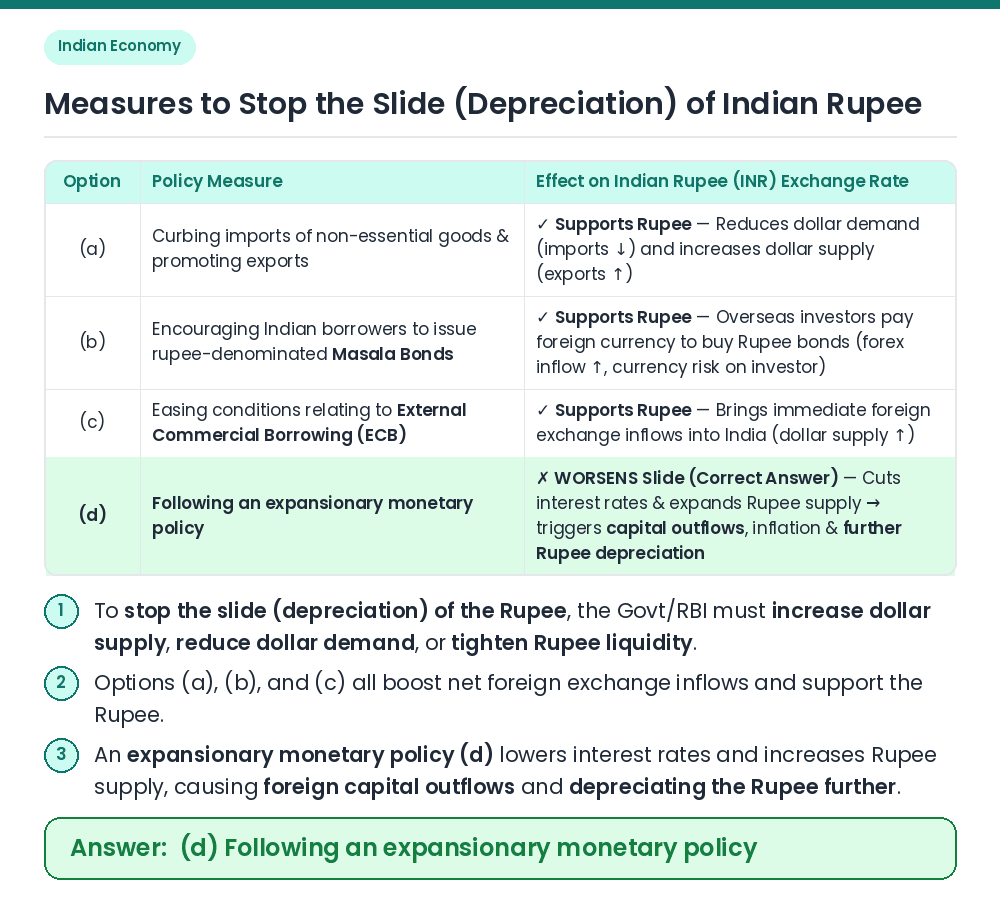
Answer: (D) Following an expansionary monetary policy
Given / Concept: A slide (depreciation) of the Indian Rupee against the US Dollar occurs when demand for dollars exceeds supply in the forex market. Measures that Support the Rupee — a, b, c: ⇒ Option (a): Curbing non-essential imports reduces dollar outflow, and promoting exports increases dollar inflow. ⇒ Option (b): Issuing Masala Bonds (Rupee-denominated bonds issued offshore) brings foreign currency into India while shifting exchange-rate risk to the overseas investor. ⇒ Option (c): Easing External Commercial Borrowing (ECB) norms encourages foreign capital inflows. Measure that Weakens the Rupee — d: An expansionary monetary policy (cutting repo rate / CRR, buying bonds via OMOs) increases Rupee supply and lowers domestic interest rates, leading to higher inflation and FPI capital outflows ⇒ This accelerates the slide of the Rupee rather than stopping it (Option d ✓). Result: Following an expansionary monetary policy is not a measure taken to stop the slide of the Indian rupee. Related Facts: • Contractionary (Tight) Monetary Policy: To defend a falling currency, central banks raise interest rates (repo rate) and sell dollars from forex reserves. • Masala Bonds: First issued by the International Finance Corporation (IFC) in 2014 to fund infrastructure projects in India. Correct Answer: (d) Following an expansionary monetary policy