Civil Services Examination · Question 87
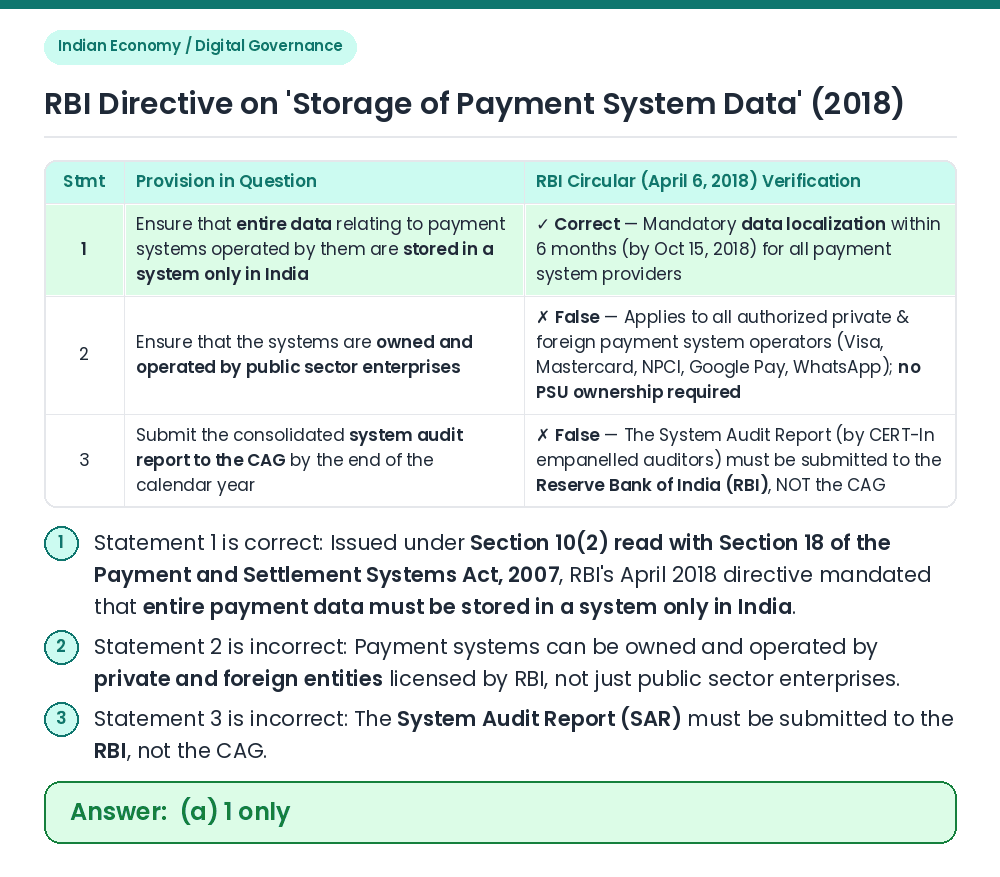
Consider the following statements : The Reserve Bank of India's recent directives relating to 'Storage of Payment System Data', popularly known as data diktat, command the payment system providers that 1. they shall ensure that entire data relating to payment systems operated by them are stored in a system only in India 2. they shall ensure that the systems are owned and operated by public sector enterprises 3. they shall submit the consolidated system audit report to the Comptroller and Auditor General of India by the end of the calendar year Which of the statements given above is/are correct?
Show answer & explanationShow explanation
Answer: (A) 1 only
Given / Concept: On 6 April 2018, the Reserve Bank of India issued a directive on 'Storage of Payment System Data' under Section 10(2) read with Section 18 of the Payment and Settlement Systems Act, 2007. Statement 1 Check: All payment system providers were directed to ensure that within six months, the entire data relating to payment systems operated by them (end-to-end transaction details) are stored in a system only in India (Statement 1 ✓). Statements 2 & 3 Check: Payment systems in India are operated by private, foreign, and non-profit entities (e.g., Visa, Mastercard, NPCI, Paytm, Google Pay) and do NOT have to be owned by public sector enterprises (Statement 2 ✗) ⇒ Providers must submit a System Audit Report (conducted by CERT-In empanelled auditors) to the RBI, NOT to the Comptroller and Auditor General (CAG) (Statement 3 ✗). Result: Only Statement 1 is correct. Related Facts: • Cross-Border Transactions Exception: For the foreign leg of a cross-border transaction, a copy of the data may also be stored abroad if required, provided the complete data is stored in India. • Payment and Settlement Systems Act, 2007: Designates the RBI as the authority for regulation and supervision of payment systems in India. Correct Answer: (a) 1 only