Civil Services Examination · Question 90
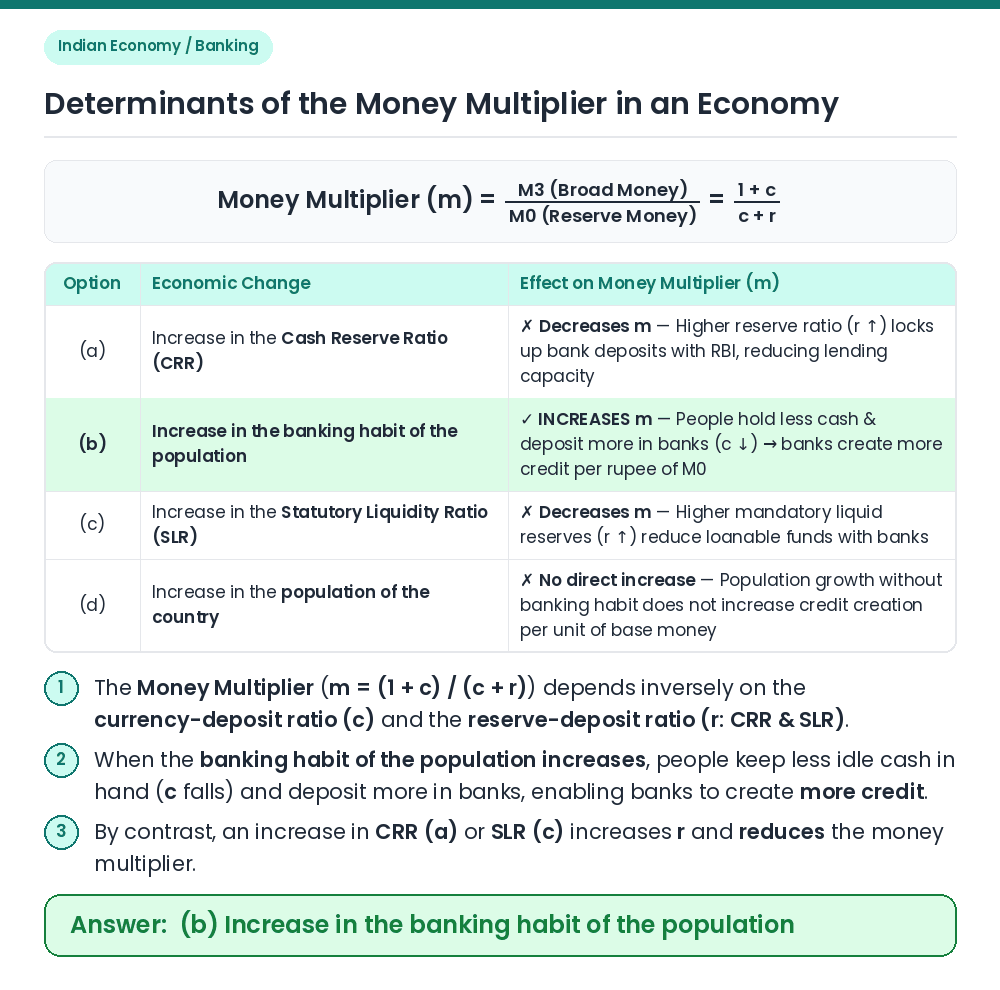
The money multiplier in an economy increases with which one of the following?
Show answer & explanationShow explanation
Answer: (B) Increase in the banking habit of the population
Given / Concept: The Money Multiplier (m = M3 / M0) measures how much broad money supply (M3) is created by the commercial banking system for every unit of Reserve / High-Powered Money (M0) issued by the central bank: ⇒ m = (1 + c) / (c + r), where c = Currency-to-Deposit Ratio (CU/DD) and r = Reserve Ratio (CRR + SLR). Evaluating Options a & c: Increasing the Cash Reserve Ratio (CRR) or Statutory Liquidity Ratio (SLR) increases the reserve ratio (r) ⇒ Banks can lend out a smaller fraction of deposits, so the money multiplier decreases (Options a and c ✗). Evaluating Option b: When the banking habit of the population increases (via financial inclusion and digital payments), people hold less cash in hand and deposit more in banks ⇒ The currency-deposit ratio (c) decreases, allowing banks to multiply credit and increasing the money multiplier (Option b ✓). Result: The money multiplier increases with an increase in the banking habit of the population. Related Facts: • Reserve Money (M0 / High-Powered Money): Currency in circulation + Bankers' deposits with RBI + 'Other' deposits with RBI. • Maximum Credit Multiplier (Simple Form): When cash leakage c = 0, Money Multiplier = 1 / CRR. Correct Answer: (b) Increase in the banking habit of the population