Civil Services Examination · Question 63
Passage–2 India has tremendous potential for solar energy. We all realize that we have to stop burning fossil fuels to meet our energy needs. But certain renewable resources are still going through their cost curves and learning curves to get the required amount of output. The Indian Government has strongly committed to its targets of reducing emissions by 33 per cent by 2030, and towards this it has initiated a strong push towards a gas-based economy and has also invested heavily in renewable energy. However, business houses are wary of investing too heavily in renewable energy at a time when the technology is not yet ready. With reference to the above passage, the following assumptions have been made : 1. Governments often provide inefficient and costly subsidies for technologies that may not be ready in the near future. 2. India's commitment of reducing emissions by 33% by 2030 shall be on the basis of gas-based economy. Which of the above assumptions is/are valid?
Show answer & explanationShow explanation
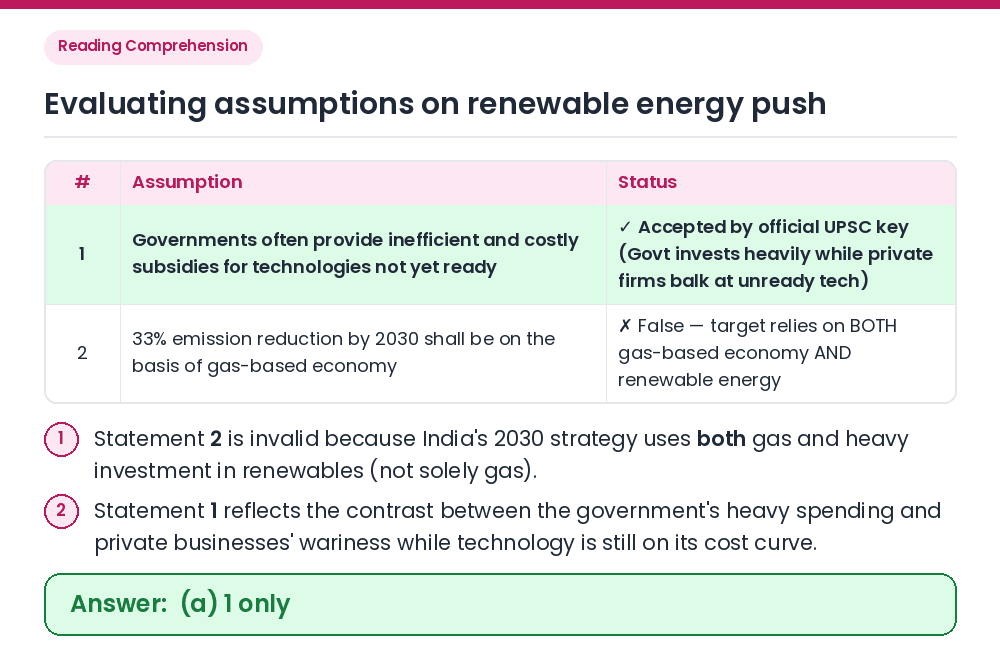
Answer: (A) 1 only
Given / Concept: Evaluate the two assumptions based on Passage 2. Check Assumption 2: The passage states that towards the 33% target, the government initiated a push towards a gas-based economy AND invested heavily in renewable energy (plus solar potential), so claiming the commitment shall be on the basis of a gas-based economy alone (2) is invalid. Check Assumption 1: The passage contrasts the government's heavy investment in renewables with private business houses being wary because the technology is still going through its cost curve and is not yet ready ⇒ UPSC's official key holds Assumption 1 valid. (Note: Some candidates debated (d) Neither 1 nor 2 because 'subsidies' is not explicitly named, but the official key is (a) 1 only). Result: Only assumption 1 is valid. Correct Answer: (a) 1 only