Civil Services Examination · Question 64
Passage–3 Genome editing is different from genome modification. Genome editing typically involves finding the part of a plant genome that could be changed to render it less vulnerable to disease, or resistant to certain herbicides, or to increase yields. Researchers use 'molecular scissors' to dissect the genome and repair it, which is a process that occurs naturally when plants are under attack from diseases and can throw up new mutations that enable the plant to survive future attacks. This evolutionary process can effectively be speeded up now that it is possible to examine plant genomes in detail in laboratories, and create mechanisms through which the relevant genes can be altered very precisely. With reference to the above passage, the following assumptions have been made : 1. Genome editing does not require the transfer of genes from one plant to another. 2. Through genome editing, the chosen genes can be altered precisely in a manner akin to the natural process that helps plants to adapt to the environmental factors. Which of the above assumptions is/are valid?
Show answer & explanationShow explanation
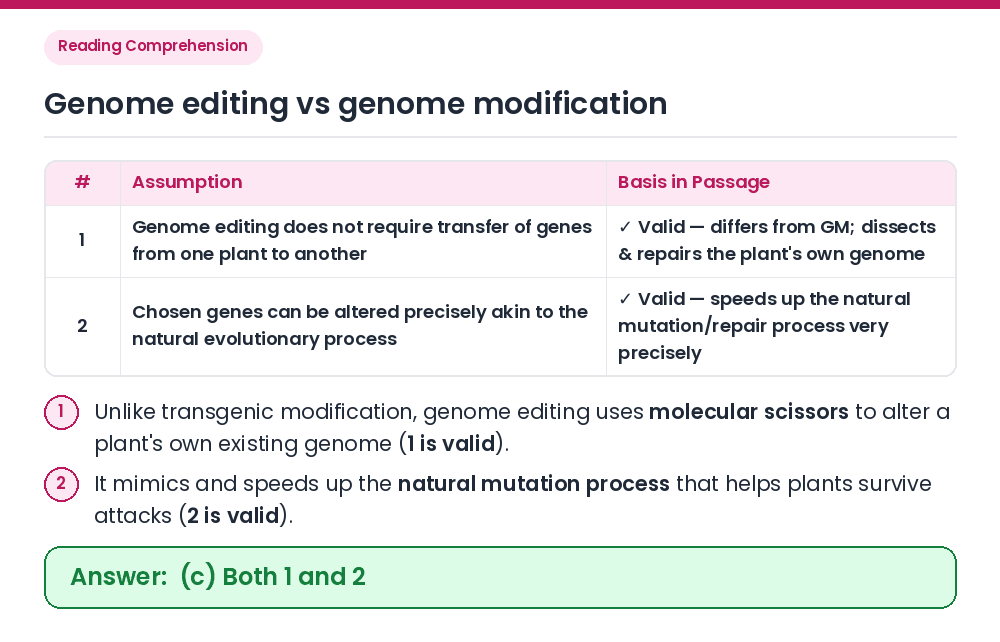
Answer: (C) Both 1 and 2
Given / Concept: Check the validity of both assumptions from Passage 3 on genome editing. Check Assumption 1: Genome editing is distinguished from genome modification (transgenics); it finds and repairs a part of the plant's own genome using 'molecular scissors' without transferring foreign genes ⇒ 1 is valid. Check Assumption 2: The passage explicitly states that this repair process 'occurs naturally when plants are under attack' and can now be done 'very precisely' in laboratories to speed up evolution ⇒ 2 is valid. Result: Both 1 and 2 are valid assumptions. Correct Answer: (c) Both 1 and 2