Civil Services Examination · Question 66
Passage–5 In Part III of the Constitution, which assures people certain fundamental rights, Article 25 proclaims that “all persons are equally entitled to freedom of conscience and the right freely to profess, practise and propagate religion”. What people fail to notice is that this proclamation is prefixed with the words “subject to public order, morality, health and to the other provisions of this Part”, which set conditions precedent for the legal protection of religious practices of any community. The closing words of this prefatory rider in Article 25 virtually constitute a subordination clause placing other fundamental rights mentioned in Part III over and above the right to religious freedom. Among those other fundamental rights is the right to equality before law and equal protection of laws—assured at the outset and elaborated in later articles to mean, inter alia, that the State shall not deny equal protection of laws to any person or group of persons on the basis of religion alone. What is the most logical inference from the above passage?
Show answer & explanationShow explanation
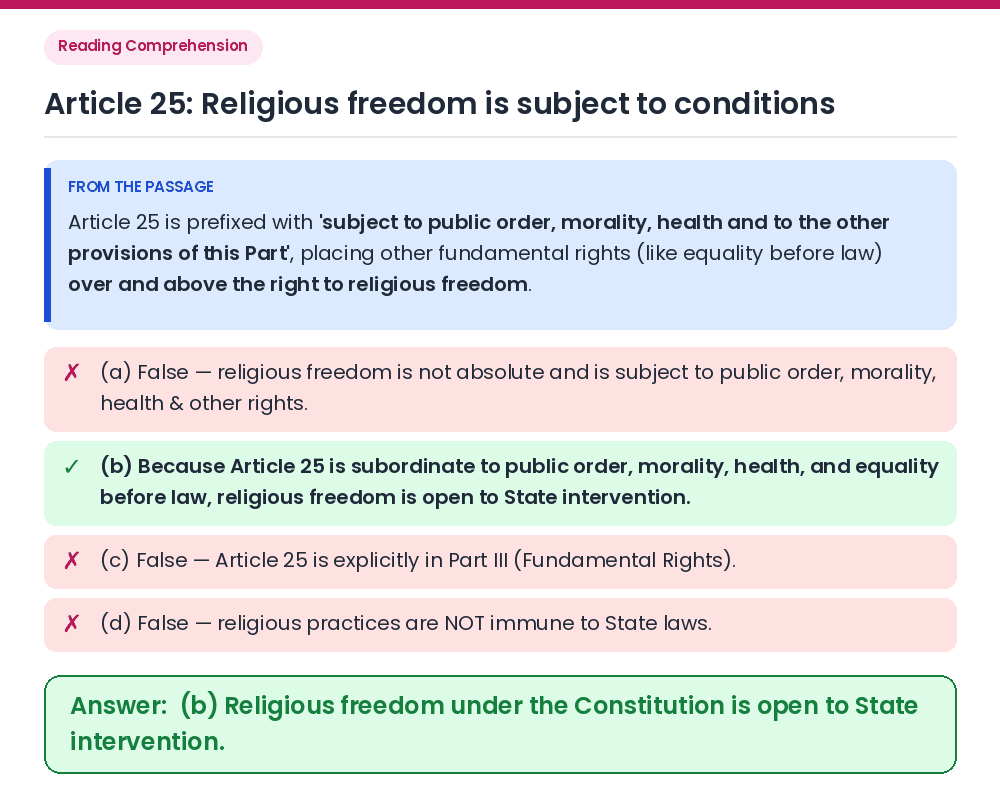
Answer: (B) Religious freedom under the Constitution is open to State intervention.
Given / Concept: Determine the logical inference from Passage 5 regarding Article 25 of the Constitution. Passage Analysis: Article 25 makes the right to religious freedom explicitly 'subject to public order, morality, health and to the other provisions of this Part' (such as equality before law and equal protection of laws). Eliminate Others: Because of this subordination clause, religious practices are not immune to State laws (ruling out a and d), while Article 25 is still part of Part III Fundamental Rights (ruling out c). Result: Religious freedom under the Constitution is conditional and open to State intervention. Correct Answer: (b) Religious freedom under the Constitution is open to State intervention.