UP Super TET · Question 70
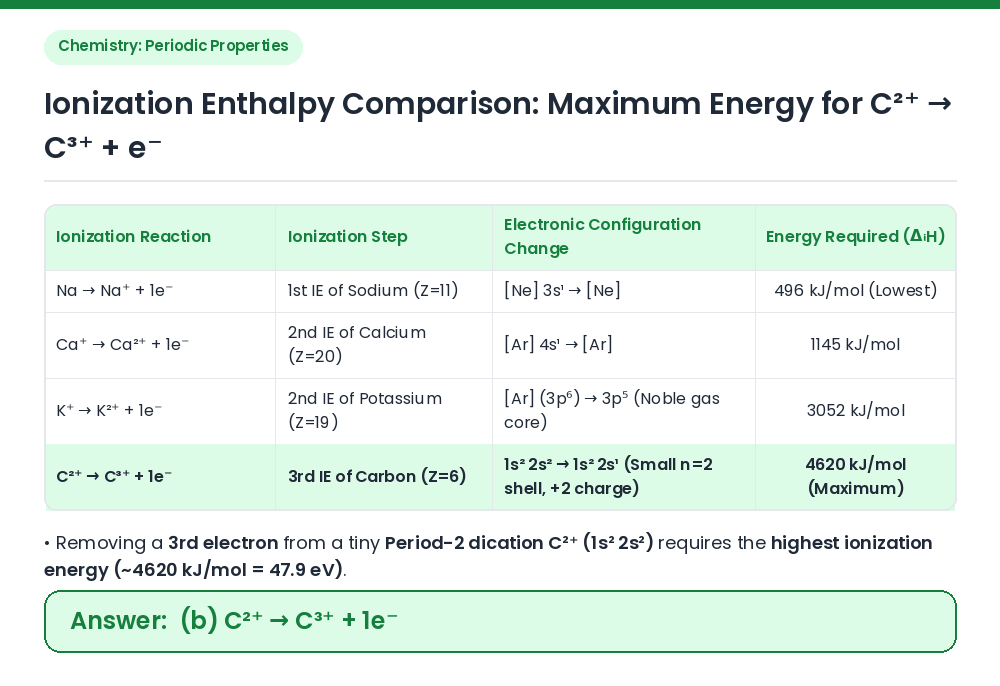
Which of the following reactions will need maximum amount of energy?
Show answer & explanationShow explanation
Answer: (B) C²⁺ → C³⁺ + 1e⁻
Given: Four ionization reactions: (a) 1st IE of Na, (b) 3rd IE of C, (c) 2nd IE of Ca, and (d) 2nd IE of K. Concept: Successive ionization enthalpies always increase rapidly (IE₃ ≫ IE₂ > IE₁) because it is much harder to pull a negatively charged electron away from an already highly positively charged ion of very small radius. Compare principal quantum shell n and ionic charge: In C²⁺ → C³⁺ + 1e⁻, an electron is removed from the filled 2s² subshell (n = 2, very close to the nucleus) of a doubly charged cation (C²⁺), requiring ΔᵢH₃ = 4620 kJ/mol (47.89 eV). Compare with K⁺ → K²⁺ + 1e⁻: Although K⁺ has a noble-gas [Ar] configuration (1s² 2s² 2p⁶ 3s² 3p⁶), the electron is removed from the larger n = 3 shell of a singly charged ion (K⁺), requiring ΔᵢH₂ = 3052 kJ/mol (31.63 eV), which is significantly less than 4620 kJ/mol. Compare with Na and Ca⁺: Na → Na⁺ + e⁻ needs only 496 kJ/mol (5.14 eV) and Ca⁺ → Ca²⁺ + e⁻ needs 1145 kJ/mol (11.87 eV). Result: C²⁺ → C³⁺ + 1e⁻ requires the maximum energy (4620 kJ/mol). Common mistake: Picking K⁺ → K²⁺ + e⁻ because K⁺ has an [Ar] core, overlooking that 3rd ionization from the n = 2 shell of tiny C²⁺ requires 1568 kJ/mol more energy. Correct Answer: (b) C²⁺ → C³⁺ + 1e⁻