Civil Services Examination · Question 61
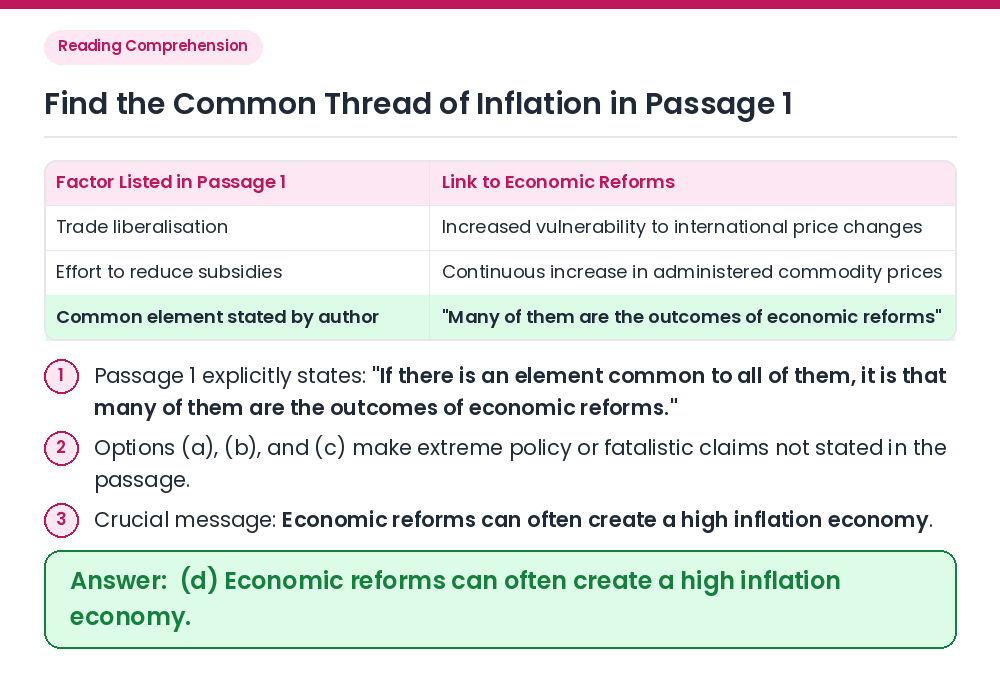
Directions for the following 7 (seven) items: Read the following four passages and answer the items that follow. Your answers to these items should be based on the passages only. Passage – 1 India has suffered from persistent high inflation. Increase in administered prices, demand and supply imbalances, imported inflation aggravated by rupee depreciation, and speculation – have combined to keep high inflation going. If there is an element common to all of them, it is that many of them are the outcomes of economic reforms. India's vulnerability to the effects of changes in international prices has increased with trade liberalisation. The effort to reduce subsidies has resulted in a continuous increase in the prices of commodities that are administered. What is the most logical, rational and crucial message that is implied in the above passage?
Show answer & explanationShow explanation
Answer: (D) Economic reforms can often create a high inflation economy.
Given / Concept: Passage 1 links persistent inflation drivers (imported inflation from trade liberalisation and rising administered prices from subsidy reduction) to economic reforms. Identify the Author's Core Thesis: The passage states, "If there is an element common to all of them, it is that many of them are the outcomes of economic reforms." Eliminate Extreme Options: Options (a) and (b) call for rejecting trade liberalisation entirely, and (c) brings in "continuing poverty" and total hopelessness—none of which are in the passage. Result: The passage directly implies that economic reforms can often create a high inflation economy. Correct Answer: (d) Economic reforms can often create a high inflation economy.